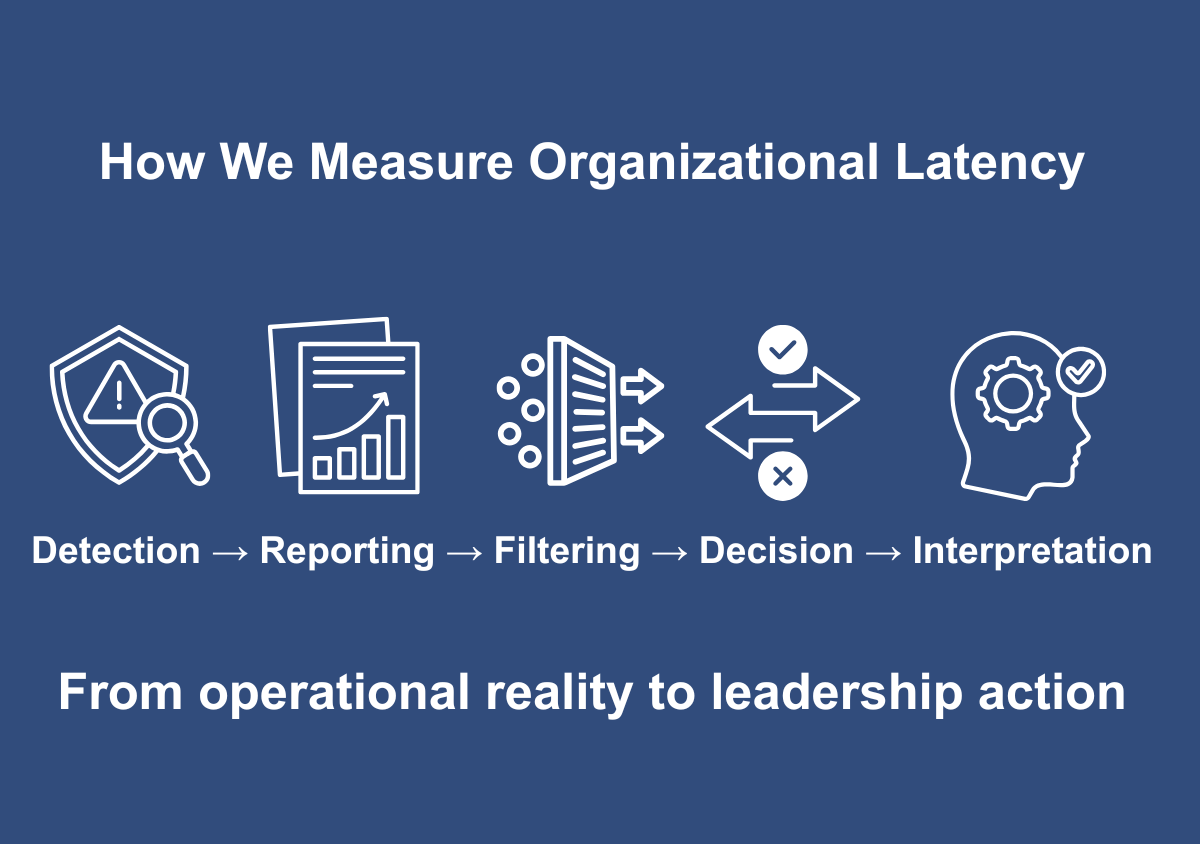
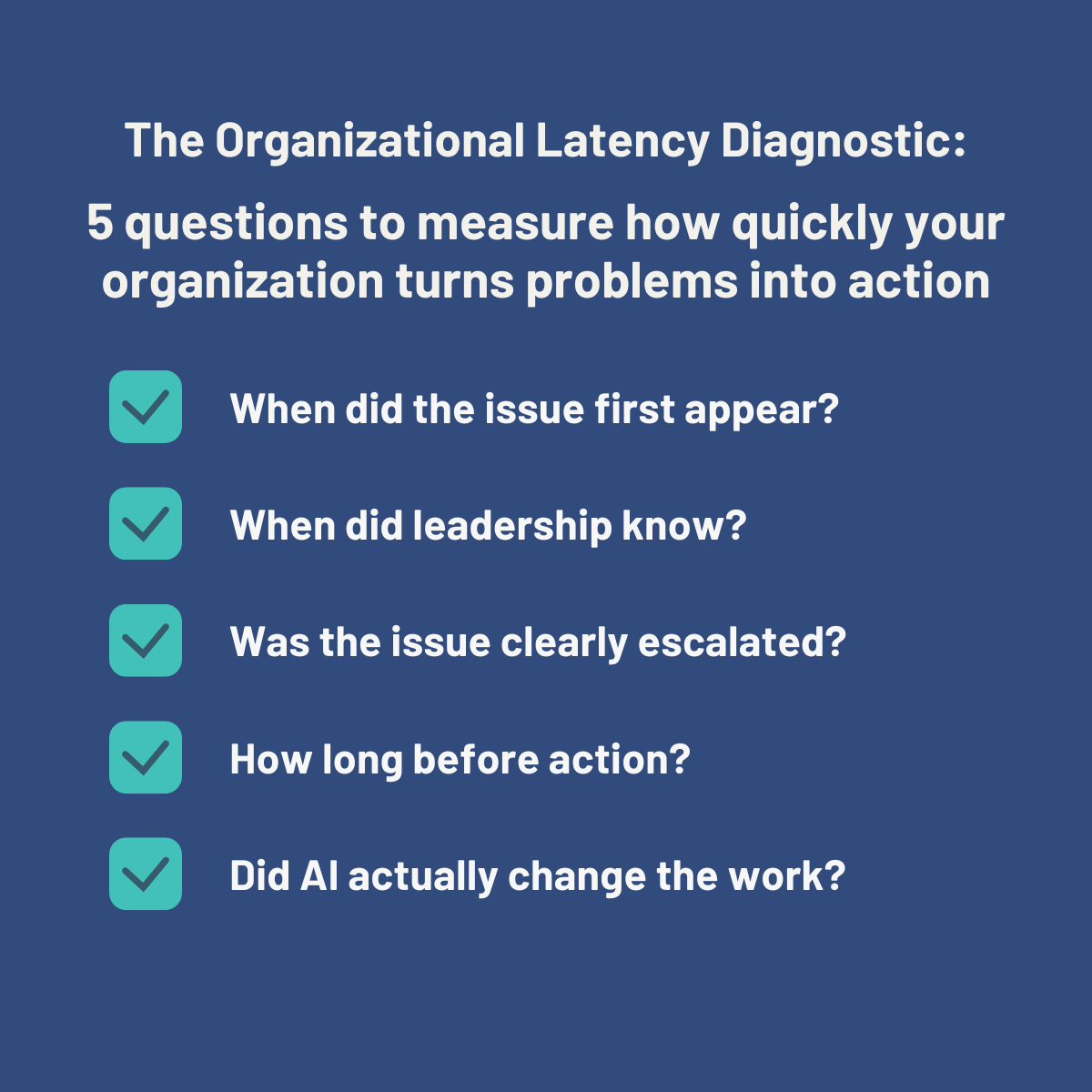
Organizational Latency: The Hidden Cost of Delayed Insight

Every organization has a number it never measures: how long it takes for a real problem to reach someone who can act on it. Call it organizational latency. A working definition: Organizational latency is the delay between when an important event occurs, such as a market shift or internal problem, and when the organization understands … Read more

The End of the Annual Engagement Model and What Replaces It in the Autonomous Era

The Annual Survey was Built for a Slower Organization For thirty years, the dominant tool for understanding what was happening inside organizations was the annual engagement survey. It was a product of its environment: organizations moved more slowly, information was scarce, and asking thousands of people a question at the same time was, at one … Read more

The Workplace Reality Leadership Doesn’t Always See

Modern teams adapting to workplace pressure and changing priorities

Most organizations are asking employees to adapt quickly, and the employee experience inside many companies is becoming increasingly complex. Teams are being asked to move faster, do more with fewer resources, incorporate AI into their workflows, and maintain performance during constant operational change. From a leadership perspective, the priorities are often centered around: At the … Read more

What Happens When Team Visibility Is Limited Across an Organization

Broken chain representing operational disconnects caused by limited team visibility

Most organizations already have access to large amounts of information. Teams share updates, leaders review reports, meetings take place regularly, and communication happens constantly across the business. On the surface, it can feel like there should be a clear understanding of what is happening across the organization. In practice, that visibility is often limited because … Read more

How to Improve Team Visibility and Identify Issues Beneath the Surface of Your Organization

Most leaders already spend time trying to stay informed. They review reports, sit in meetings, and ask for updates. On the surface, it feels like they should have a clear view of what is happening across their teams. In practice, that visibility is limited. The problem is not that organizations lack information. It is that … Read more

Why Reports, Meetings, and Surveys Don’t Give You Real Team Visibility

Most organizations believe they have team visibility. They review reports, meet with managers, and run employee surveys to stay informed. However, they still miss what is actually happening across their teams. Issues build inside day-to-day work. By the time they appear in reports or discussions, execution is already affected. This is not a leadership issue. … Read more

Why Leaders Lack Team Visibility (And How to Fix It Before Execution Slips)

Most leaders believe they have visibility into their teams. They review reports, meet with managers, and track performance metrics. However, they still miss what is happening inside the work that drives execution. Problems develop quietly in day to day work. By the time they surface, execution is already affected. This is not a leadership problem. … Read more

What is AI Team Intelligence? A Better Way to Understand What’s Happening Across Teams

Most organizations lack true team intelligence, a clear understanding of what is actually happening across teams in real time. Instead, leaders rely on meetings, status updates, and dashboards that provide an incomplete and often delayed view of execution. As a result, decisions are made based on partial information, and issues are often identified only after … Read more

How to Identify AI Use Cases in Your Organization (That Actually Solve Real Problems)

Teams experiment with tools. Leadership pushes for results. AI gets added into workflows.

But one question remains:

In most organizations, this challenge shows up in a few common ways:

– AI initiatives that don’t scale beyond pilots
– Tools used in isolated workflows
– Teams experimenting without clear direction
– Difficulty demonstrating measurable impact

The Core Problem: AI Starts With Tools, Not Problems

In many organizations, enterprise AI initiatives begin with:

  • New platforms 
  • New capabilities 
  • New mandates 

But they do not begin with a clear understanding of:

  1. Where work is breaking down 
  2. Where inefficiencies exist 
  3. Where opportunities are being missed 

As a result, teams often:

  • Implement AI in isolated workflows 
  • Build pilots that do not scale 
  • Struggle to demonstrate measurable outcomes 

AI is not the issue.
Lack of visibility into real operations is a problem.

How to Identify AI Use Cases That Actually Work

The most effective AI use cases share three key traits:

1. They solve real operational problems

Not theoretical improvements, but actual issues:

  • Delays 
  • Misalignment 
  • Inefficiencies 
  • Missed opportunities

2. They are cross-functional

High-impact AI use cases rarely sit within one team.

They typically span:

  • Operations 
  • Product 
  • Customer experience 
  • HR

3. They are visible in day-to-day work

The strongest signals do not come from dashboards.

They come from:

  • Team conversations 
  • Status updates 
  • Recurring issues 
  • Frontline feedback
Why Identifying AI Use Cases Is Difficult in Practice

Identifying AI use cases in an enterprise setting is challenging because most organizations already rely on:

  • Dashboards 
  • Reports 
  • Analytics tools 

These systems are designed to measure outcomes. They do not explain why problems are happening.

What is often missing:

  • Visibility into day-to-day execution 
  • Early signals of issues 
  • Patterns across teams 

The most valuable data is not structured. It lives in conversations.

For example, onboarding issues, recurring delays, or customer complaints often surface in team discussions long before they appear in reports.

A Better Approach: Start With What Teams Are Experiencing

Leading organizations are shifting from tool-first to input-first approaches when identifying AI use cases.

Step 1: Capture what is actually happening

  • What are teams working on? 
  • What is slowing them down? 
  • What issues keep recurring? 

Step 2: Turn input into structured insight

  • Identify patterns 
  • Group recurring themes 
  • Surface hidden friction 

Step 3: Translate insight into action

  • Prioritize what matters. 
  • Assign ownership 
  • Track outcomes 

This creates a foundation where AI can:

  • Identify patterns at scale 
  • Highlight risks early 
  • Recommend actions 
Where AI Use Cases Typically Emerge

When organizations follow this approach, high-value AI use cases become clear. They most often emerge in:

Operational visibility

  • Understanding what teams are actually doing 
  • Identifying delays and blockers early 

Execution and alignment

  • Detecting cross-team misalignment 
  • Improving coordination across functions 

Customer and employee insight

  • Identifying onboarding issues 
  • Uncovering churn drivers 
  • Surfacing feedback patterns 

Decision-making

  • Prioritizing actions based on real signals 
  • Improving leadership visibility 
From AI Exploration to Real Outcomes

Most organizations do not struggle with AI because of a lack of tools.

They struggle because:

  • The right problems are not visible. 
  • Use cases are not grounded in real operations. 
  • Insight is not connected to execution. 

AI initiatives often miss the problems that matter most.

The organizations that succeed take a different approach.

They start with understanding how their organization actually operates, then apply AI where it can make a measurable difference.

How Tezox Helps Identify AI Use Cases

Tezox is designed to support this approach.

Instead of relying on dashboards or surveys alone, Tezox captures what teams are actually experiencing through structured input.

It turns that input into:

  • Clear patterns
  • Identified issues 
  • Prioritized actions

This enables organizations to:

  • Uncover the real problems AI should solve 
  • Identify high-impact AI use cases 
  • Connect insight directly to execution
Final Thought

If your organization is exploring enterprise AI, the most important question is not:

“What AI should we build?”

It is:

“What problems do we actually need to solve?”

Everything else follows from there.

Explore Tezox

If you are looking to identify practical AI use cases tied to real operational issues, Tezox offers a free pilot to help you uncover these patterns and act on them. https://scout.tezox.com

You can also see how it works here:

Tezox TeamOps: AI-Powered Weekly Team Intelligence for Real Organizational Insight

Most organizations have no reliable way to know what is actually happening across their teams week to week. Tezox TeamOps fixes that with a weekly AI-guided intelligence loop that gives every leader — from frontline managers to the C-suite — a clear, honest view of execution…