Most companies know important problems often begin long before they reach an executive dashboard, operating review, or leadership meeting.
A customer issue starts repeating. A workflow begins to break down. A team creates a workaround. An AI tool is being used, but the work itself is not changing.
By the time leadership sees the issue clearly, the organization may have already lost days, weeks, or months.
What Is Organizational Latency?
Organizational Latency is the time between something important happening inside the business and leadership having enough information and context to act.
The Organizational Latency Index is designed to measure that delay.
If you have not taken the Organizational Latency Diagnostic yet, you can start here:
https://www.tezox.com/insights/organizational-latency-diagnostic/
Organizational Latency may show up as a customer issue that was visible to support weeks before it appeared in an executive review. It may be a handoff problem that teams have already worked around before leadership sees the cost. It may be an AI deployment that looks active in usage reports but has not meaningfully changed how work gets done.
These are not always failures of attention, often, they are failures of measurement.
Most organizations measure outcomes after the delay has already happened: revenue, retention, productivity, engagement, customer satisfaction, project completion, and AI usage.
Those metrics matter, but they often tell leadership what happened after the organization has already lost time. Organizational Latency asks a different question:
How long did it take the organization to know what was happening and act on it?
Building on Don Scheibenreif’s work on autonomous business and Donald Sull’s work on execution, we believe this gap is becoming more important as companies move toward AI-enabled operating models. If organizations are going to become more adaptive, leadership needs a clearer view of how quickly problems are detected, escalated, understood, and acted on.
That requires a different kind of management metric.
What Is the Organizational Latency Index?
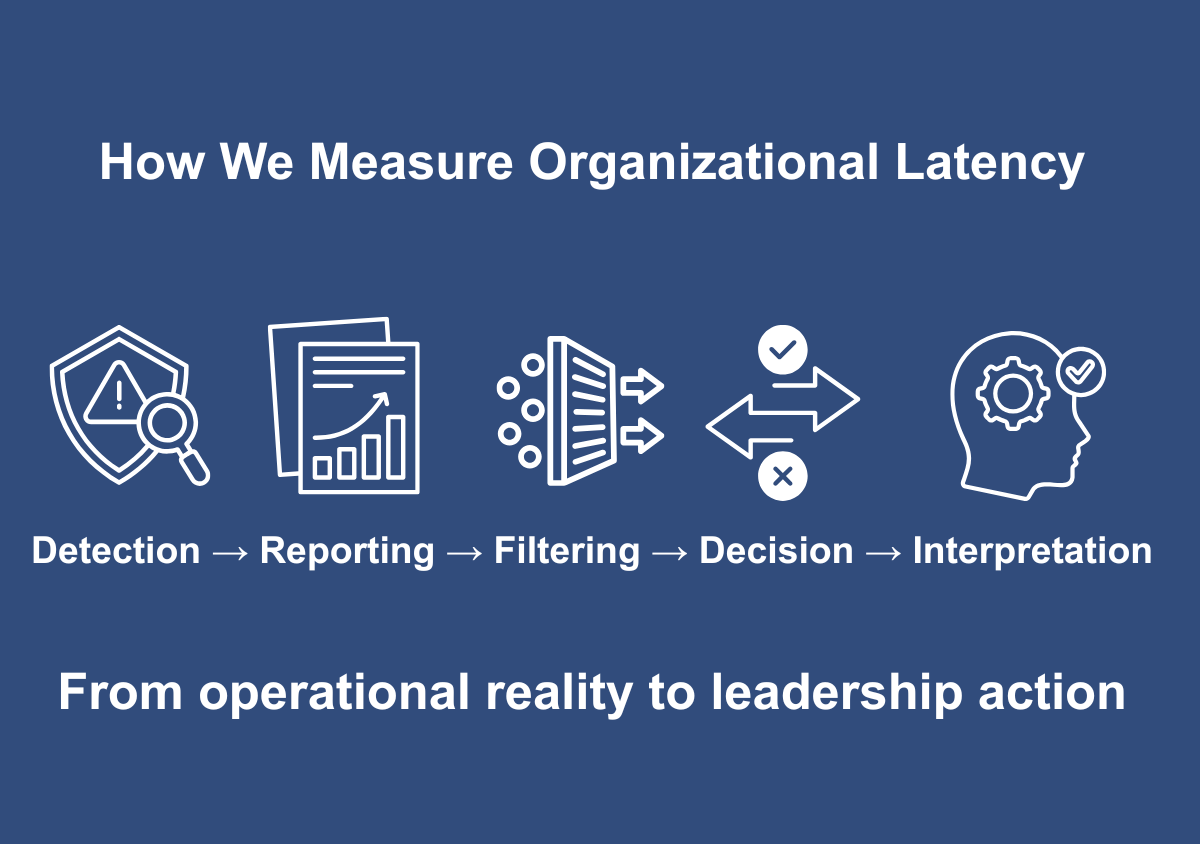
The Organizational Latency Index is a framework for measuring how quickly an organization turns important problems into action.
It produces a 0–100 score based on five components:
- Detection latency
- Reporting latency
- Filtering latency
- Decision latency
- Interpretation latency
Each component measures a different place where time can be lost between operational reality and leadership action.
The value of the Organizational Latency Index is not only the final score. It is the decomposition. A company does not simply learn that it is slow. It learns where slowness is entering the system.
That distinction matters.
A leadership team may assume it has a decision-speed problem when the real issue is earlier in the chain. The issue may not be that executives are slow to act. It may be that problems are not detected early enough, escalated clearly enough, or interpreted accurately enough before action becomes possible.
1. Detection Latency
Detection latency measures how long it takes for an important issue, risk, opportunity, or change in the business to be noticed by someone. This is the earliest point in the chain.
The observed signals may include customer complaints, support patterns, workflow exceptions, employee comments, missed handoffs, quality issues, delayed approvals, repeated rework, system alerts, or regional performance changes.
The key question is:
When did the issue first become knowable inside the organization?
This does not mean the moment the executive team knew. It means the earliest reasonable point at which someone inside the company had evidence that something important was happening.
Detection latency is computed by comparing that first observable point with the point at which the issue was first recognized as meaningful.
In practice, this often requires triangulation. A support ticket may show the first customer complaint. A team message may show when employees noticed the pattern. A project review may show when the problem became visible enough to discuss.
The goal is not perfect forensic precision. The goal is to establish a reasonable estimate of when the issue first existed inside the operating reality of the business.
2. Reporting Latency
Reporting latency measures how long it takes for a known issue to enter a formal or semi-formal reporting channel.
This is where many organizations lose time.
A team may know a process is breaking. A manager may know a customer issue is repeating. A region may know a policy is not working. But the information may not enter a status report, executive update, operating review, risk register, or leadership conversation for days or weeks.
The observed signals include status reports, meeting notes, escalation records, issue trackers, project updates, customer experience summaries, performance dashboards, and leadership briefings.
The key question is:
When did the issue move from local awareness into a channel leadership could reasonably see?
Reporting latency is computed by comparing the first known local awareness date with the first formal reporting date.
This distinction matters because many organizations assume that if something is known somewhere, it is visible to leadership.
That is rarely true. Knowledge inside a team is not the same as visibility inside a management system.
3. Filtering Latency
Filtering latency measures what happens to information as it moves upward.
This component is not only about time. It is also about distortion.
An issue may be reported quickly, but softened as it travels through the organization. A serious execution risk becomes a minor delay. A customer pattern becomes an isolated concern. A failed adoption effort becomes a change-management opportunity. A team-level workaround becomes evidence of resilience rather than evidence that the operating model is not working.
The observed signals include changes in language across reporting layers, differences between frontline descriptions and executive summaries, repeated reframing of issues, delayed escalation, and the removal of urgency or specificity from updates.
The key question is:
Did the issue reach leadership with the same clarity, urgency, and meaning it had closer to the work?
Filtering latency is computed by examining the difference between the first clear description of the issue and the version that reached decision-makers.
This is one of the harder components to reduce to a single number because filtering includes both time and meaning. But it is too important to ignore. A company can have fast reporting and still have slow truth.
4. Decision Latency
Decision latency measures how long action waits once leadership has enough information to respond.
This is the most familiar form of delay.
The observed signals include executive meeting dates, decision logs, approvals, budget changes, ownership assignments, follow-up actions, escalation outcomes, and changes to operating plans.
The key question is:
Once leadership had enough information to act, how long did it take for a decision or meaningful action to occur?
Decision latency is computed by comparing the first point at which leadership had sufficient context with the point at which action was taken. This does not mean every issue requires immediate executive action. Some decisions require deliberation. Some require legal, financial, operational, or customer impact review.
The purpose is not to punish careful decision-making but to separate thoughtful deliberation from avoidable delay.
5. Interpretation Latency
Interpretation latency measures how long it takes the organization to understand what the information means and what decision should change because of it.
This is the newest and increasingly important component.
In an AI-enabled organization, leaders may have more outputs, alerts, usage metrics, recommendations, workflow data, and automation reports than ever before. But more AI output does not automatically create better executive understanding.
An AI pilot may show high usage. Workflows may show more completed tasks or a dashboard may show increased activity, but leadership still needs to know whether customer outcomes improved, manual work decreased, decision quality increased, or teams actually changed how work gets done.
That is interpretation latency.
The observed signals include conflicting interpretations of the same data, uncertainty about whether AI usage equals business impact, delayed understanding of workflow change, unclear ownership of AI outcomes, and long gaps between activity metrics and operating decisions.
The key question is:
How long did it take leadership to understand what the information meant and what action should follow?
This component is especially important because interpretation cannot depend entirely on one person. A CIO can explain systems. A business leader can explain outcomes. A team can explain workarounds. But no single individual can serve as the full translation layer for AI adoption, workflow change, human-machine handoffs, and operational impact.
The interpretive capacity has to exist in the management system itself.
How the Organizational Latency Index Is Scored
The Organizational Latency Index produces a score from 0 to 100.
Each of the five components contributes up to 20 points.
Higher scores indicate that important issues are generally detected, escalated, understood, and acted on quickly. Lower scores suggest that issues may spend too much time inside the organization before leadership has enough information and context to respond.
The current scoring bands are:
90–100: Best-in-Class
70–89: Healthy
40–69: Average Enterprise
20–39: At Risk
0–19: Critical
These bands are working estimates. They are designed to help leadership teams interpret their initial score and compare their organization against a developing baseline, and not meant to imply scientific precision at this stage.
The score is useful because it gives leaders a way to compare the organization’s response pattern against a structured framework. It also creates a shared language for discussing where time is being lost.
Why Most Companies Have Never Tried to Measure Organizational Latency
Most organizations focus on outcome metrics such as revenue, retention, productivity, engagement, customer satisfaction, project completion, and AI usage. These measures are important, but they typically reveal what happened only after delays have already affected the business.
Organizational Latency looks at a different dimension of performance: how long it takes for the organization to recognize what is happening and respond effectively. Measuring that gap is more difficult because the answer is rarely found in a single system or report. Instead, it is spread across meetings, reporting structures, team conversations, workflows, and leadership decisions.
The process also requires leaders to confront an uncomfortable reality: information is often known locally long before it becomes visible at the executive level. Yet that challenge is precisely what makes the measurement valuable. While outcome metrics help explain results after the fact, latency metrics provide insight into how the organization processes information and takes action while there is still time to influence the outcome
Three Caveats About Measuring Organizational Latency
The Organizational Latency Index is designed to create a useful management signal, not to pretend that complex organizational behavior can be measured with perfect precision.
Three caveats are important.
- The methodology is still in pilot.
The benchmarks will move as the cohort expands.
Early responses are useful for pattern recognition, but they should not be treated as final industry norms. The purpose of the first year is to build a stronger baseline, improve the scoring model, and learn how latency varies by company size, operating model, function, and AI maturity.
- Some components are easier to measure than others.
Detection, reporting, and decision latency can often be estimated from timestamps, meetings, reports, tickets, reviews, and decision records.
Filtering and interpretation are harder.
Filtering requires comparing how an issue changes as it moves upward. Interpretation requires understanding when information became actionable, not just when it appeared.
Interpretation latency is the hardest component to measure, but it may also become one of the most important.
- The index is most useful in its first year as a directional signal.
A score of 58 should not be treated as meaningfully different from a score of 61.
But a company scoring in the 40–69 range is likely operating with a very different response pattern than a company scoring above 90 or below 20.
In its first year, the Organizational Latency Index should be used as a directional signal, not a precision instrument.
That honesty matters.
Overclaiming would make the metric less useful. The goal is not to create another management score for its own sake. The goal is to make organizational delay visible enough that leadership teams can discuss it, reduce it, and improve how quickly the business turns reality into action.
The Real Purpose of the Organizational Latency Index
Leadership teams often sense organizational delay long before they can describe it clearly. The Organizational Latency Index provides a shared language for identifying and discussing that challenge.
It encourages leaders to ask:
Where are we losing time?
How does information lose clarity as it moves through the organization?
When does AI activity fail to translate into meaningful operating insight?
Why do we sometimes confuse reporting with understanding?
What changes to the management system would help the organization respond faster?
Ultimately, the purpose of the Organizational Latency Index is not to create another score.
Its value lies in helping leaders understand how quickly their organization turns reality into action.
Take the Organizational Latency Diagnostic here:
https://www.tezox.com/insights/organizational-latency-diagnostic/